


We started in the parking lot in light jackets and shorts.
We checked the weather, planned our hike and had what we thought we would need if we got chilly.
I knew that the weather could change in the mountains.
I just didn’t understand yet how quickly.
We were hiking up the Ammonoosuc Ravine Trail toward the Lakes of the Clouds in New Hampshire, where we planned to spend the night before summiting Mt. Washington the next morning.
While not a long trail, the elevation gain is significant at over 900 ft/mile. For me, that means I need to get ready to WORK for the goal.
While we were hiking up, clouds started moving in. We thought we might see some rain, so our goal became – get to the hut before the weather turns.
We made it just in time to summit Mt. Monroe, which sits very close to the hut, even though it was completely socked in. It was my first 4000-footer summit in New Hampshire and while proud, I was spent.
We settled into the hut for the night, set up our bunks and grabbed dinner.
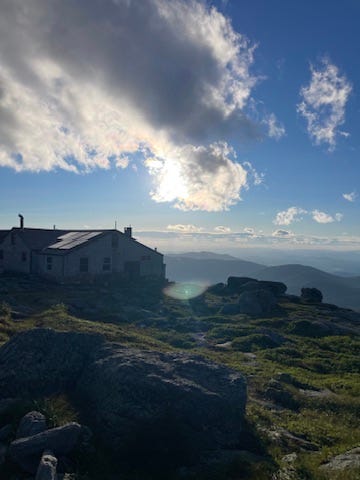
That’s when it all changed.
The hut caretakers warned us a storm had shifted – we would be getting a major drop in temperature and increase in wind overnight. Suddenly our plan to summit Mt Washington the following day wasn’t looking possible.
I spent the night listening to the winds slam the doors of the hut and wondering how in the world we would get back down the mountain.
By morning, the forecast included 90mph gusts on the summit.
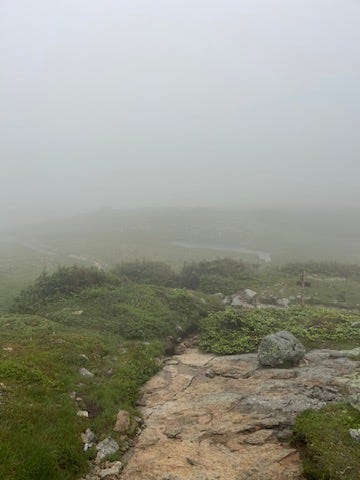
We changed the plan.
Luckily, the caretakers are skilled at assisting hikers and they were able to give us accurate weather updates, help us understand the conditions and choose a safer route back to the car.
At the time, this felt like a dramatic change to a trip we had carefully planned, but looking back it became one of the biggest lessons I’ve learned as a hiker:
The forecast you hoped for doesn’t matter. The weather you actually get does.
I’m not here to help you become a meteorologist, I’m just a regular hiker who has learned the hard way to check certain things before I commit to a trail – and be willing to change the plan when those things tell me I should.
Here’s what I do:
Start with the regular forecast
First, I check the regular weather app I use at home. This will give you a general guideline for what the next few days look like. Personally, I like Weather Underground – I’ve found it to be the most accurate for rain and hourly forecasts. Whatever app you like is fine, this is just my preference and to be honest, my husband and I disagree 😉
Look for trends, like storms that may be coming and probability of rain. This is just the first pass and you can begin a week out or so. At this point I’m looking for trends, not getting emotionally attached to the hike day yet.
Then I check the forecast for the actual mountain.
This is where things start to matter more. Elevation changes the weather a LOT. It gets colder, can be windier and in the White Mountains weather can get stuck in certain spots, like Franconia Notch. The more you look at this stuff, the better you get at seeing the patterns.
I also check National Weather Service (NWS) because it separates forecasts by elevation and includes metrics like wind, gusts, cloud cover, rain and summit temps. All of these will help you make safe decisions before heading out. 45 degrees with full sun and no wind is VERY different than 45 degrees, full cloud cover and 20 mph winds.
In the White Mountains, I also check the Higher Summits Forecast
When in the White Mountains, I also check the Mount Washington Observatory Higher Summits Forecast (MWOBS). This resource is specific to the area and updates twice daily. Mount Washington is known to have the world’s worst weather so they know what they are talking about! They even provide trail cam footage at some of the White Mountain summits.
I look again for things like:
Summit temps
Wind speeds
Wind gusts
Wind chill (VERY important)
Cloud cover
Rain/snow/ice
Timing of weather changes
And don’t skip the forecast discussion. It dives deeper into weather timing and nuance that the charts miss. Think of it like reading the whole article instead of just the headline, if you will. The more aware you are of weather and potential changes, the better prepared you’ll be out there.
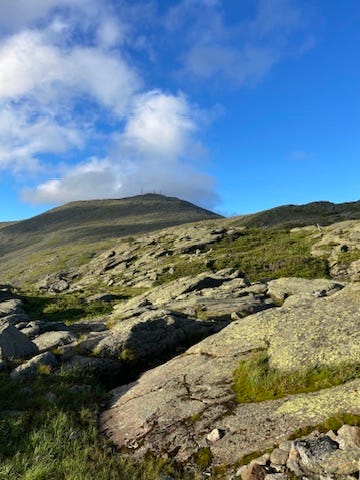
I pay particular attention to the wind
You may have noticed there were three wind metrics I check before a hike. Here’s why: Wind creates temperature differences AND safety issues when on exposed ridges. Yes, temperature and rain are important, but I consider the wind the biggest factor for both comfort AND safety. When you’re above treeline and the wind picks up, it’s a very particular kind of feeling!
I try to look where a trail might be exposed, what gusts are predicted to be in that area when I plan to be there and whether I want to be above treeline at that time. This is one area where I might pivot to another trail or cancel a hike altogether if needed.
Look at when the weather is changing
I also check the hourly forecast. When is the rain going to start? Is the wind picking up at a certain time? Is the temperature predicted to drop at a certain point? Might wet rocks get icy with the wind?
This helps you to choose your start times wisely – it might mean an early start, so you’re off trail by the time weather rolls in. MWOBS recently wrote an article about how quickly summit temps can hit freezing and turn those damp surfaces icy and you want to make sure you know!
Check everything again
The night before and the morning of the hike, I check everything again. I have all the apps organized into a folder on my phone, so they are easy to find and access. So again, here’s how I check:
General forecast
NWS mountain forecast
Higher Summits (MWOBS)
Summit cams, if available
The forecast I checked three days ago doesn’t matter if the weather has changed overnight.
Match the weather to the hike
You get to decide if a hike is in your skillset! So here’s where you use your experience to make the best choice for YOU. If the weather above treeline makes a hike unattainable for you, you can always pivot to a sheltered, wooded trail and still get outside.
Just like mileage doesn’t tell you everything about a trail, a single weather check doesn’t either. it’s smart to consider all the other factors that make a hike comfortable and fun: terrain, exposure, elevation, bailouts and even your own experience level.
Changing the plan isn’t failing a hike
Phew! I know that was a lot of information if you haven’t considered mountain weather this way before.
But you don’t have to go nuts trying to become an expert.
And you certainly don’t have to hike above treeline or choose big, exposed mountains in order for your hike to count.
You just need to be prepared for the hike you do choose.
Take the time to explore and learn new skills that will keep you heading outside more often. And the ones that will keep you safe while you do it.
Because here’s the thing: Changing the plan isn’t failing the hike.
You can always choose to stay at a lower elevation, do a shorter hike or even just hike another day.
Just like my own Mt. Washington story, the summit wasn’t the point.
I still hiked the Ammonoosuc Ravine Trail. I still stayed at Lakes of the Clouds. I still summited my first New Hampshire 4000-footer.
And I still had an incredible experience without putting myself on Mt. Washington in 90 mph gusts, just because that was the original plan.
These days, I am more comfortable making these types of decisions. I learned to check the mountain weather in a systematic way and it’s made me more confident in my trail decisions instead of just hoping for the best.
You don’t need to be an expert to make better hiking decisions; you just need to know where to look.
My “before I leave” weather checklist:
Trailhead forecast
Summit/elevation forecast
Temps
Wind speeds/wind gusts
Wind chill
Rain/storm timing
Cloud cover
Current conditions
And then I ask myself one final question:
Do these conditions match the hike I chose?
Great article! Very informative! Thank you from a beginner. :)